Why Your Restaurant is Losing 30% Profit to Aggregators
In the modern digital dining era, being visible online is no longer optional. However, many restaurant owners are discovering that the “convenience” of third-party delivery aggregators comes at a staggering cost. While these platforms provide a steady stream of orders, they often siphon off a massive portion of the revenue, leaving businesses struggling to cover their basic overhead.
To build a sustainable future, savvy owners are switching to an Online Food Ordering System for Restaurant that they own and control. This shift allows brands to stop “renting” their customers and start owning their profits.
1. The Commission Trap: How 30% Erases Your Margin
The most immediate threat to your bottom line is the standard commission fee charged by major delivery apps. Most restaurants operate on a net profit margin of 10% to 15%. When an aggregator takes 30% of the gross sale, they aren’t just taking a cut; they are effectively putting the restaurant into a deficit for that specific order.
- Fixed vs. Variable Loss: Unlike your rent, which is a fixed cost, aggregator fees grow as your business grows, punishing your success.
- Invisible Fees: Beyond the base commission, restaurants often face “tablet fees,” “marketing fees,” and “order processing fees.”
- Menu Inflation: To survive, many restaurants raise prices on apps, which can lead to customer dissatisfaction and a poor brand reputation.
2. The Loss of Customer Relationship and Data
When a customer orders through a third-party app, they are a customer of the app, not your restaurant. You never receive their email address, phone number, or ordering preferences. This lack of data prevents you from building long-term loyalty or marketing to them directly.
- No Direct Retargeting: You cannot send a “we miss you” coupon to a customer who hasn’t ordered in a month because you don’t have their contact info.
- Platform Dependency: If the aggregator decides to change their algorithm or delist you, your digital business vanishes overnight.
- Generic Experience: Your brand is reduced to a small square on a screen, squeezed between competitors and generic advertisements.
Comparison: Third-Party Aggregators vs. In-House White-Label Systems
| Feature | Third-Party Aggregators | In-House White-Label System |
| Commission Fee | 20% – 35% per order | 0% (Fixed monthly or one-time) |
| Data Ownership | Controlled by the platform | 100% Owned by the restaurant |
| Branding | Minimal (Platform-centric) | Full Brand Customization |
| Customer Loyalty | Loyalty is to the App | Loyalty is to YOUR Restaurant |
| Payout Speed | Weekly or Bi-weekly | Instant/Direct to your gateway |
3. Operational Inefficiency: The “Tablet Hell” Factor
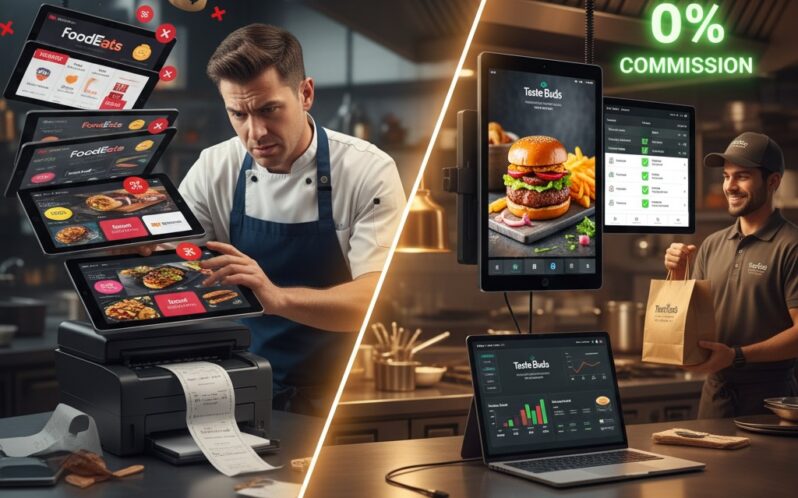
Managing multiple third-party tablets is a logistical nightmare for kitchen staff. Each platform has its own notification sound, interface, and printing requirements. This fragmentation leads to increased human error, missed orders, and delayed preparation times.
- Manual Entry Errors: Staff often have to manually re-type orders from an aggregator tablet into the restaurant’s POS, leading to mistakes.
- Counter Space Clutter: Having 5-6 different tablets at the front desk takes up valuable space and distracts front-of-house staff.
- Inconsistent Menus: Updating a price or removing a “sold-out” item across five different platforms is time-consuming and often forgotten.
4. The Hidden Costs of Poor Delivery Execution
When a third-party driver is late, rude, or mishandles the food, the customer blames the restaurant, not the app. You lose the customer’s trust and a potential 5-star review, even though the delivery logistics were entirely out of your hands.
- Negative Reviews: One cold burger delivered late can result in a permanent 1-star review on Google or Yelp.
- No Quality Control: You have no say in the driver’s vehicle cleanliness or the thermal bags used (if any).
- Refund Arbitrariness: Aggregators often issue refunds to customers for minor issues without consulting the restaurant, taking the money directly from your account.
Financial Breakdown: $50 Order Comparison
| Component | Aggregator Order (30% Fee) | Your Own System (Fixed Cost) |
| Order Total | $50.00 | $50.00 |
| Commission/Fee | -$15.00 | -$0.00 |
| Food Cost (30%) | -$15.00 | -$15.00 |
| Labor/Overhead | -$10.00 | -$10.00 |
| Net Profit | $10.00 | $25.00 |
5. Reclaiming Your Brand with Digital Independence
The solution isn’t to stop delivery altogether—it’s to change how you deliver. By implementing a dedicated Online Food Ordering System for Restaurant, you bridge the gap between digital convenience and financial sanity. You offer the same “tap-to-order” ease without the parasitic fee structure.
- Search Engine Optimization: Your own ordering website can rank on Google, capturing local traffic that would otherwise go to the aggregators.
- Direct Marketing: Use the data you collect to run SMS and Email campaigns that drive “slow day” traffic.
- Loyalty Integration: Implement a points system that rewards customers for ordering directly from you, further increasing their lifetime value.
6. Menu Cannibalization and Price Inflation
Aggregators don’t just add new orders; they often shift your existing high-margin dine-in customers to low-margin delivery orders. To survive the 30% commission, restaurants often inflate their app prices, which can sometimes make a meal cost up to 70% more than it would in-person.
- Dine-In Shifts: Research shows that while delivery apps provide some new sales, a significant portion is simply diverted from your traditional, more profitable dine-in business.
- Nutritional Compromise: To maintain margins under high fees, some restaurants are forced to substitute quality ingredients with cheaper, processed alternatives.
- Customer Friction: Massive price markups on apps (sometimes doubling the menu price) can frustrate loyal customers and drive them toward cheaper competitors.
7. The Vulnerability of Platform Dependency
Relying on third-party apps creates a dangerous dependency. If an aggregator changes its search algorithm, increases its fees, or experiences a technical outage, your digital revenue stream could disappear instantly without warning.
- Algorithmic Risk: Your restaurant’s visibility is at the mercy of the platform; if they deprioritize your listing, your order volume drops immediately.
- Rising Costs: Aggregator fees have climbed from 10% to over 30% in recent years, proving that these platforms prioritize their own growth over restaurant sustainability.
- Platform Instability: If a major delivery platform shuts down or exits your market, restaurants without their own ordering system are left with no way to reach their digital audience.
8. Strategic Advantage of First-Party Data in 2025
In the current market, data is a restaurant’s most valuable asset for survival. Third-party apps guard this data, but a direct Online Food Ordering System for Restaurant gives you “First-Party Data” that you can use to personalize the guest experience and drive predictable growth.
- Hyper-Personalization: Use order history to send automated, targeted offers to guests based on their favorite dishes or average spend.
- Predictive Analytics: Modern systems use data to help you forecast labor needs, engineer your menu for higher profit, and even decide when to remodel or expand.
- Privacy Compliance: Collecting data directly ensures you are compliant with privacy laws like GDPR, building trust that aggregators often compromise.
9. Improving Kitchen Efficiency and Order Accuracy
“Tablet mayhem” is a leading cause of kitchen stress and errors. Direct ordering systems integrate with your POS to automate the flow, ensuring that the kitchen receives orders exactly as the customer intended, without manual re-entry.
- Automated Syncing: Integrated systems ensure your online menu matches your real-time inventory, preventing customers from ordering out-of-stock items.
- Reduced Manual Errors: Eliminating the need for staff to re-key orders from a tablet to a POS reduces mistakes and speeds up preparation times.
- Unified Reporting: Instead of consolidating spreadsheets from five different apps, you get a single real-time view of your total sales and labor ratios.
10. Enhancing the Total Guest Experience
When you control the ordering platform, you control the narrative. Direct systems allow you to offer features that aggregators often skip, such as scheduled pre-orders, detailed ingredient highlighting, and seamless loyalty rewards.
- Pre-Order Capabilities: Allow customers to place orders outside of business hours so your team starts the day with a pre-set list of tasks.
- Upselling Opportunities: Use built-in tools to suggest add-ons like garlic bread or extra sauces naturally during the checkout process, increasing average order value by up to 35%.
- Direct Communication: Resolve issues instantly through your own support channels before they turn into public 1-star reviews on third-party sites.
Reclaim Your Independence with FoodAppsCo™
In an industry where margins are everything, staying on third-party platforms is no longer a viable long-term strategy for many. By switching to a dedicated Online Food Ordering System for Restaurant, you take back your profit, your data, and your brand’s future.
FoodAppsCo™ offers the technology you need to succeed without the 30% commission tax. Our white-label solutions are the gold standard for restaurants looking to thrive in 2025.
Would you like me to help you draft a specific marketing campaign to announce your new direct ordering platform to your customers?
Reclaim Your Profits with FoodAppsCo™
Transitioning away from aggregator dependency is a major step toward long-term profitability. FoodAppsCo™ provides world-class white-label solutions designed to give restaurant owners the upper hand in the digital economy. We don’t just provide an app; we provide a complete business growth engine.
Why Choose FoodAppsCo™?
- 0% Commission Forever: We believe your profits should stay with you. Our model focuses on empowering your business, not taxing it.
- Full Data Access: Get a 360-degree view of your customers, their habits, and their feedback to make data-driven decisions.
- Enterprise-Grade Technology: Our systems are built to handle high volumes, featuring seamless POS integrations and real-time order tracking.
- Multi-Branch Support: Manage one location or a thousand from a single, centralized dashboard.
Our white-label products are designed to be “invisible” so your brand stays front and center. From custom iOS/Android apps to responsive web ordering, we provide the tools you need to beat the aggregators at their own game.