Why a Self-owned Food Delivery App for Restaurant is better than Using Uber Eats
1) Introduction
The restaurant industry has reached a pivotal crossroad where digital presence is no longer optional. For years, many establishments relied on third-party aggregators to handle their online presence, trading high commissions for immediate visibility. However, as the market matures, the limitations of these platforms are becoming clear. Smart operators are now shifting toward independence by investing in Food Ordering Mobile Apps For Restaurants to secure their long-term viability.
Relying on external marketplaces often leads to a “hollowed-out” business model where the restaurant does all the labor while the platform captures the most valuable assets: profit margins and customer data. By taking ownership of the digital storefront, owners can reclaim their identity and protect their bottom line. The move toward a self-owned platform isn’t just about saving money; it’s about establishing a direct line of communication with the local community that cannot be interrupted by an algorithm.
Modern technology has made this transition easier than ever before. With the right Food Ordering Mobile Apps For Restaurants, a local business can offer an experience that rivals the industry giants. This article will break down the strategic advantages of ownership over “renting” your customers from third-party marketplaces, providing a clear roadmap for restaurants to transition toward a more profitable and sustainable digital future.
2) What “Self-owned Food Delivery App” Means
In the simplest terms, a self-owned delivery app is a custom-branded mobile application built specifically for your restaurant. Unlike a marketplace where you are one of hundreds of listings, this app is dedicated solely to your brand. When you deploy Food Ordering Mobile Apps For Restaurants, you are giving your customers a direct portal to your menu, optimized for their mobile devices.
Ownership means you have total control over the user interface, the ordering flow, and the payment processing. You aren’t just a row in a search result; you are a destination on the customer’s phone home screen. This software typically includes a customer-facing app, a kitchen management dashboard, and a driver application. This complete ecosystem ensures that your staff and your customers stay synchronized throughout the entire fulfillment process.
Most importantly, using Food Ordering Mobile Apps For Restaurants under a white-label or self-owned model means you are not sharing your hard-earned traffic with competitors. When a customer opens your app, they see your specials, your branding, and your loyalty rewards. It is a digital extension of your physical dining room, designed to provide the same level of service and quality that your patrons expect when they walk through your front door.
3) The Real Cost of Third-Party Marketplaces (Fees, Margin Pressure, and Control)
The hidden tragedy of third-party delivery marketplaces is the erosion of profit margins. Many of these platforms charge commissions ranging from 20% to 35% on every single order. For an industry that often operates on thin margins, this cost can be the difference between a thriving business and a failing one. By contrast, Food Ordering Mobile Apps For Restaurants typically operate on a fixed monthly fee or a significantly lower transaction cost.
Beyond the financial fees, there is the cost of lost control. Third-party aggregators often dictate pricing, delivery zones, and even how your menu is displayed. They may run promotions that you didn’t approve or bundle your food with other restaurants in a way that affects quality. When you use Food Ordering Mobile Apps For Restaurants, you are the one in the driver’s seat. You decide when to take orders, how far you are willing to deliver, and exactly how much each item costs.
There is also the “search visibility” trap. Third-party platforms prioritize restaurants that pay for advertising or offer deep discounts. This creates a “race to the bottom” where you must constantly lower your prices or pay extra fees just to be seen by your own regular customers. Investing in your own Food Ordering Mobile Apps For Restaurants eliminates this predatory cycle, ensuring that your marketing efforts build your own asset rather than someone else’s platform.
4) Why Owning Customer Data Changes Everything (Retention, Remarketing, and LTV)
Data is the currency of the 21st century. When a customer orders through a third-party marketplace, that platform keeps the customer’s email, phone number, and order preferences. You receive a first name and an order number, but you have no way to reach that person again. With Food Ordering Mobile Apps For Restaurants, every transaction provides you with a rich profile of your customer base.
Owning this data allows for highly effective remarketing. If you know a customer hasn’t ordered in three weeks, your system can automatically send a personalized push notification with a “We Miss You” discount. This level of automation significantly increases the Lifetime Value (LTV) of each customer. By using Food Ordering Mobile Apps For Restaurants, you turn a one-time diner into a repeat fan through consistent, data-driven engagement.
Retention is far cheaper than acquisition. It costs five times more to find a new customer than it does to keep an existing one. Third-party platforms thrive on customer “churn”—they don’t care which restaurant the user orders from as long as they stay on the app. Your goal is the opposite. With your own Food Ordering Mobile Apps For Restaurants, you focus on building a community of regulars who choose you every time because you provide a personalized, frictionless experience.
5) How a Self-owned App Improves Profit Per Order (With Simple Examples)
To understand the financial impact, consider a $50 order. On a third-party marketplace, after a 30% commission ($15) and potentially other hidden service fees, the restaurant might only take home $32-$35 before food and labor costs. If that same restaurant uses its own Food Ordering Mobile Apps For Restaurants, they keep the full $50, minus a small flat transaction fee from the payment processor (usually around 3%).
This extra $12 to $15 per order adds up rapidly. For a restaurant doing 20 deliveries a day, that represents an additional $300 in daily profit, or roughly $9,000 per month. This reclaimed revenue can be used to hire better staff, improve ingredients, or fund your own local marketing campaigns. By utilizing Food Ordering Mobile Apps For Restaurants, you are essentially giving yourself a massive raise on every transaction.
Furthermore, a self-owned app allows for better upselling opportunities. You can program the app to suggest a specific appetizer or a premium dessert during the checkout process. Third-party apps often bury these options or make them difficult to navigate. With your own Food Ordering Mobile Apps For Restaurants, you can design the “path to purchase” to maximize the Average Order Value (AOV), further boosting your profitability per customer interaction.
6) Branding & Customer Experience Advantages (Consistency, Trust, and Repeat Orders)
Branding is more than just a logo; it is the promise of a specific experience. When your food arrives in a generic bag via a generic marketplace, your brand is diluted. When customers use your specific Food Ordering Mobile Apps For Restaurants, they are interacting with your brand’s colors, voice, and values from the moment they get hungry. This consistency builds deep trust and emotional connection.
The user experience is also more streamlined. Marketplace apps are cluttered with thousands of options, which can lead to “decision paralysis.” Your dedicated app is a clean, focused environment. By offering a high-quality interface through Food Ordering Mobile Apps For Restaurants, you make it as easy as possible for the customer to get what they want. Frictionless ordering is a primary driver of repeat business in the digital age.
Trust is further reinforced through direct communication. If an order is running late, you can communicate directly with the customer through your app. There is no middleman to blame or hide behind. This accountability is valued by consumers. When you provide a reliable, branded experience through Food Ordering Mobile Apps For Restaurants, you create a sense of professional reliability that generic third-party aggregators simply cannot match.
7) Marketing Playbook: How to Drive Direct Orders
Launching an app is only half the battle; the other half is getting people to use it. Moving customers away from aggregators requires a clear strategy. Here are the most effective tactics to drive direct orders to your platform:
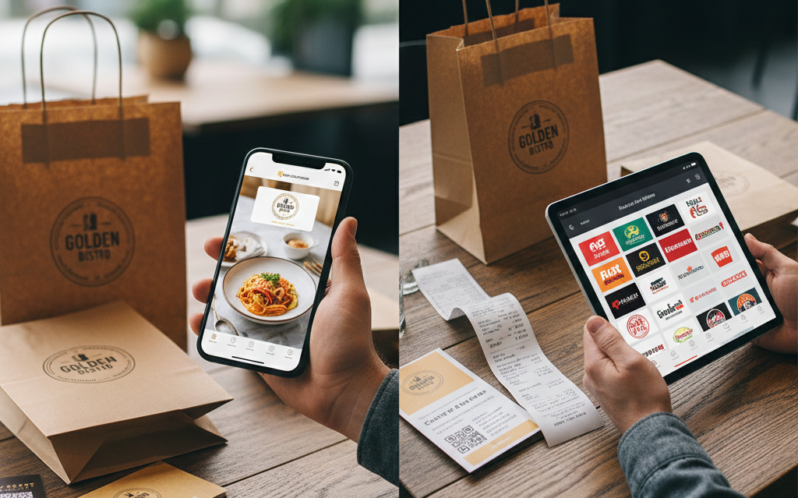
- In-Package Marketing: Include a physical flyer or a QR code in every delivery bag that offers a discount on the customer’s first order through your own app.
- Exclusive Menu Items: Offer certain “app-only” specials or “secret menu” items that can only be ordered via your Food Ordering Mobile Apps For Restaurants.
- Social Media Integration: Use your Instagram and Facebook bios to link directly to your app store listings rather than third-party sites.
- First-Order Incentives: Provide a significant one-time discount (e.g., $10 off) for downloading the app, as the long-term savings on commissions will quickly cover this cost.
- Google My Business Optimization: Ensure your “Order” button on Google Search leads directly to your own web ordering or app link.
By consistently promoting your Food Ordering Mobile Apps For Restaurants, you train your most loyal customers to use the channel that is most beneficial for your business. Over time, your reliance on third-party traffic will decrease, and your independent platform will become your primary revenue driver.
8) Loyalty & Retention Features That Actually Work
Loyalty programs are the engine of recurring revenue. Unlike third-party platforms that offer generic points, your app can offer rewards that truly matter to your customers. Integrating a robust loyalty system into your Food Ordering Mobile Apps For Restaurants ensures that users have a compelling reason to return. Here are features that drive real retention:
- Tiered Rewards: Create levels (e.g., Silver, Gold, Platinum) based on monthly spend to incentivize customers to order more frequently.
- Push Notification Reminders: Send automated alerts about lunch specials or limited-time offers directly to the user’s pocket.
- Birthday and Anniversary Rewards: Use the data collected by your Food Ordering Mobile Apps For Restaurants to send personalized treats on special days.
- Referral Bonuses: Encourage your fans to become advocates by giving them credits when they successfully invite a friend to download the app.
- Subscription Tiers: Offer a “VIP Membership” where a small monthly fee grants the customer $0 delivery or a free appetizer on every order.
These features turn your app from a utility into a club. When customers feel like they are “earning” something back with every purchase, they are far less likely to shop around on a marketplace. A well-executed loyalty program within Food Ordering Mobile Apps For Restaurants is the ultimate defense against competitor encroachment.
9) Operational Benefits (Menus, Timing, Delivery Zones, Upsells, Promotions)
Operating your own digital platform brings a level of agility that third-party marketplaces can’t offer. If you run out of an ingredient, you can instantly toggle that item off in your Food Ordering Mobile Apps For Restaurants. There is no waiting for a support ticket or a third-party update. This real-time control reduces customer frustration and saves your staff from having to call customers to cancel orders.
You can also be much more precise with your delivery zones. Perhaps you want to deliver 5 miles away on a slow Tuesday but only 2 miles away during a busy Friday night. With your own Food Ordering Mobile Apps For Restaurants, these adjustments can be made in seconds. You can also implement “Smart Timing,” which automatically increases the delivery time estimate as the kitchen gets busier, managing customer expectations perfectly.
Furthermore, running promotions becomes a creative outlet rather than a financial burden. You can run “Flash Sales” for the next 60 minutes to clear out excess inventory or launch a “Rainy Day Special” when foot traffic is low. Because you aren’t paying a 30% commission, you have much more “margin room” to offer attractive discounts through your Food Ordering Mobile Apps For Restaurants without going into the red.
10) Comparison Table: Self-owned App vs Third-Party Marketplace
To visualize the stark differences between these two models, refer to the table below. It highlights the long-term strategic advantages of choosing a dedicated solution for your establishment.
| Feature | Self-owned App | Third-Party Marketplace |
|---|---|---|
| Commission per Order | 0% to 5% (Flat fee usually) | 20% to 35% |
| Customer Data Ownership | 100% Owned by Restaurant | Owned by the Marketplace |
| Brand Visibility | Exclusive (No Competitors) | Shared with 100s of Competitors |
| Direct Marketing Tools | Push Notifications, SMS, Email | Limited or Non-existent |
| Payout Speed | Instant (via Payment Gateway) | Weekly or Bi-weekly |
| Control Over Experience | Total Control | Standardized/Restricted |
As the table demonstrates, Food Ordering Mobile Apps For Restaurants provide a superior environment for every business metric that matters. While a marketplace might offer “reach,” a self-owned app offers “depth”—which is where true profitability and business longevity reside.
11) How to Launch in 7 Days: Step-by-Step Plan
- Choose Your Technology: Select a provider of Food Ordering Mobile Apps For Restaurants that offers a white-label solution, ensuring you don’t have to write a single line of code.
- Configure Your Brand: Upload your logo, choose your primary and secondary colors, and set up your splash screen to match your physical restaurant’s aesthetic.
- Build Your Menu: Upload your categories, items, modifiers, and descriptions. Ensure your photography is high-quality to drive conversions.
- Set Your Parameters: Define your delivery radius, set your minimum order values, and configure your operating hours within the admin panel.
- Link Your Payments: Connect your Stripe or PayPal account so that funds from orders flow directly into your business bank account.
- Submit to Stores: Finalize the app builds and submit them to the Google Play Store and Apple App Store for approval.
- Staff Training: Run a few test orders so your kitchen and delivery staff understand how to receive and update orders through the Food Ordering Mobile Apps For Restaurants.
12) Key Metrics to Track (AOV, repeat rate, CAC, LTV, refund rate, delivery time)
To ensure your platform is performing at its peak, you must monitor specific Key Performance Indicators (KPIs). The **Average Order Value (AOV)** tells you if your upselling strategies are working. A high **Repeat Rate** is the ultimate sign of health, indicating that customers are satisfied with the experience provided by your Food Ordering Mobile Apps For Restaurants.
**Customer Acquisition Cost (CAC)** helps you measure the efficiency of your marketing spend. If it costs $5 to get an app download and that customer spends $100 over their first month, you have a winning formula. **Lifetime Value (LTV)** then estimates the total revenue a customer will bring over their entire relationship with your brand. These metrics allow you to make data-driven decisions regarding your investment in Food Ordering Mobile Apps For Restaurants.
Finally, keep an eye on operational metrics like **Refund Rate** and **Delivery Time**. A high refund rate usually indicates a problem in the kitchen or with order accuracy. Long delivery times can quickly kill customer loyalty. By tracking these within your admin dashboard, you can proactively solve problems before they result in bad reviews. Successful owners use Food Ordering Mobile Apps For Restaurants as a diagnostic tool to constantly refine their operations.
13) Common Mistakes (and how to avoid them)
The most common mistake is “launching and leaving.” An app is a living part of your business, not a one-time project. You must keep your menu updated, refresh your photos periodically, and run regular promotions. If the app feels stale, customers will stop checking it. Treat your Food Ordering Mobile Apps For Restaurants with the same care as your physical storefront.
Another mistake is poor marketing. Don’t assume that because you built it, they will come. You must aggressively tell your existing customers about the app. Use every touchpoint—from your receipt to your voicemail greeting—to mention that orders are easier and cheaper through your own app. If you don’t promote your Food Ordering Mobile Apps For Restaurants, you are leaving your success to chance.
Lastly, ensure your staff is fully onboard. If the kitchen ignores the app orders because they prefer the marketplace tablets, the system will fail. Incentivize your staff based on app performance or accuracy. When everyone in the building understands that the Food Ordering Mobile Apps For Restaurants are the most profitable way for the business to operate, they will prioritize those orders, leading to better service and higher customer satisfaction.
14) Conclusion
The era of total reliance on third-party aggregators is coming to an end. For restaurants that want to protect their margins, own their customer relationships, and build a resilient brand, the path forward is clear. A self-owned digital presence is the only way to ensure that the profits of your hard work stay within your business. By shifting your focus from being a “vendor” on a marketplace to being a “brand” with its own platform, you secure your place in the future of the food industry.
If you are ready to reclaim your profit margins and build a loyal community of repeat customers, it is time to invest in your own infrastructure. Don’t wait for the next commission hike to make a change. Explore the power of Food Ordering Mobile Apps For Restaurants today and take the first step toward true digital independence and long-term business success.
15) FAQ
How much can I actually save by switching to my own app?
The savings are usually substantial. On average, restaurants using third-party marketplaces pay between $15 and $20 in commissions for every $60 worth of food sold. With your own Food Ordering Mobile Apps For Restaurants, that commission drops to nearly zero, replaced by a much smaller transaction fee or a fixed monthly cost. For a busy establishment, this can result in saving thousands of dollars every month, which directly increases your net profit without requiring you to sell a single additional dish.
Is it difficult to manage the technology on a daily basis?
Modern platforms are designed to be extremely user-friendly. If you can use a smartphone or manage a social media account, you can manage Food Ordering Mobile Apps For Restaurants. The backend allows you to update menus, change prices, and view sales data through a simple interface. Most providers also offer technical support to handle the heavy lifting of server maintenance and security, leaving you free to focus on what you do best: running a great restaurant and cooking excellent food.
What if I don’t have my own delivery drivers?
You have several options. Many restaurants use their own apps for “Pickup” or “Curbside” orders only. Others hire a few local drivers for peak times. Alternatively, many Food Ordering Mobile Apps For Restaurants can integrate with third-party “delivery-as-a-service” providers. These companies provide the driver for a flat fee per delivery, allowing you to keep your branded app and customer data while outsourcing the logistics. This hybrid model is an excellent way to transition away from high-commission marketplaces while still offering delivery.
How do I convince my customers to switch from the marketplaces to my app?
The key is providing a better value proposition. Most customers are happy to support local businesses directly if they know it helps the restaurant. Use your Food Ordering Mobile Apps For Restaurants to offer “Direct-Only” discounts, loyalty points, or exclusive menu items. You can also point out that your app-based prices are lower because you aren’t forced to inflate them to cover marketplace commissions. Once a customer sees they can get the same food for a lower price with better rewards, they will switch quickly.
Do I need to be a large chain to benefit from this?
Not at all. In fact, small and independent restaurants often benefit the most because their margins are tighter. Food Ordering Mobile Apps For Restaurants level the playing field, giving a single-location cafe the same digital sophistication as a national franchise. It allows you to compete on quality and service rather than just being a small name in a huge list. For a local favorite, a dedicated app is the best way to consolidate your local fan base and protect your territory from competitors.
Will I lose my existing marketplace customers if I launch my own app?
You don’t have to quit the marketplaces immediately. Many owners use a “hybrid” strategy: they stay on the marketplaces for new customer discovery but use their Food Ordering Mobile Apps For Restaurants to migrate those customers to a direct relationship. Once a customer has ordered once, you can include a flyer in their bag encouraging them to use your app next time for a better deal. This way, the marketplace acts as an expensive lead-generation tool, while your app serves as your high-profit retention tool.