How to Scale Your Food Delivery Startup from One City to Ten
Expanding a food delivery business from a single successful city to a regional powerhouse is a journey filled with both immense opportunity and operational complexity. The transition requires a move from “hustle-based” management to a “system-based” architecture that can replicate success across diverse urban landscapes.
Scaling effectively in 2026 demands a robust Food Delivery Marketplace System that serves as the digital backbone for your expansion. This guide outlines the strategic steps to take your startup from one city to ten without compromising quality or profitability.
Step 1: Standardize Your Core Operations
Before you can scale to ten cities, your first city must operate like a well-oiled machine. This means documenting every process, from how you onboard a new restaurant to how you handle a customer refund, ensuring the model is repeatable.
- Standard Operating Procedures (SOPs): Create clear, written guides for every role in the company to ensure consistency regardless of the location.
- Centralized Training: Use digital modules to train new city managers and dispatch teams, ensuring they uphold your brand’s service standards.
- KPI Benchmarking: Establish clear performance metrics in your “Alpha” city to serve as the target for every new market you enter.
Step 2: Implement a Scalable Technology Stack
Scaling to ten cities is impossible if your technology requires manual intervention for every order. You need a platform that can handle simultaneous high-traffic peaks across multiple time zones and handle localized data effortlessly.
- Multi-City Architecture: Ensure your system can segment data, users, and drivers by city while allowing you to manage everything from one master admin panel.
- Automated Logistics: Use AI-driven dispatching to handle thousands of orders across different urban layouts without needing a massive dispatch team.
- Cloud-Based Security: Protect customer and partner data with enterprise-grade encryption that scales as your database grows.
Comparison: Localized vs. Centralized Scaling Models
| Feature | Localized Model (City-by-City) | Centralized Model (Unified System) |
| Management | Separate teams per city | One core team with local leads |
| Tech Cost | Higher (Multiple setups) | Lower (One scalable platform) |
| Brand Control | Harder to maintain | High consistency |
| Data Flow | Fragmented across markets | Unified global insights |
Step 3: Master Hyper-Local Marketing
While your technology is centralized, your marketing must feel local. Customers in “City Two” should feel like your service was built specifically for their neighborhood, even if it is managed from a central hub.
- Localized SEO: Create city-specific landing pages that target local keywords like “Best Delivery in [City Name]” to capture organic search traffic.
- Regional Promotions: Run specific campaigns tied to local events, holidays, or even local sports team victories to build community rapport.
- Partner Collaborations: Feature “Local Favorites” on your app’s home screen to show you understand the local culinary landscape.
Step 4: Optimize Fleet and Logistics Management
Moving from one city to ten means managing a fleet of hundreds, if not thousands, of drivers. A robust Food Delivery Marketplace System must offer sophisticated driver management tools to maintain delivery times as you grow.
- Dynamic Zoning: Set specific delivery radiuses for different cities based on their unique traffic patterns and infrastructure.
- Driver Incentives: Use the app to offer heat-map bonuses and peak-hour incentives to ensure you have enough drivers in the right places at the right times.
- Hybrid Logistics: Integrate your own fleet with third-party delivery partners to ensure 100% fulfillment during unexpected demand surges.
Expansion Checklist: Assessing City Readiness
| Factor | Requirement for Launch |
| Partner Density | Minimum of 30 high-quality local restaurants signed |
| Driver Supply | Pre-onboarded fleet equal to 20% of projected peak demand |
| Legal/Tax | Local business licenses and tax configurations completed in-app |
| Marketing | Launch campaign budget secured for the first 90 days |
Step 5: Leverage Data for Geographic Expansion
The biggest advantage of scaling with a unified system is the data. By analyzing the habits of your users in your first few cities, you can predict which neighborhood in “City Ten” will be the most profitable.
- Heat Mapping: Identify where the highest demand for specific cuisines exists to recruit the right restaurant partners before you even launch.
- Customer Lifetime Value (CLV): Track which acquisition channels provide the most loyal customers across different demographics.
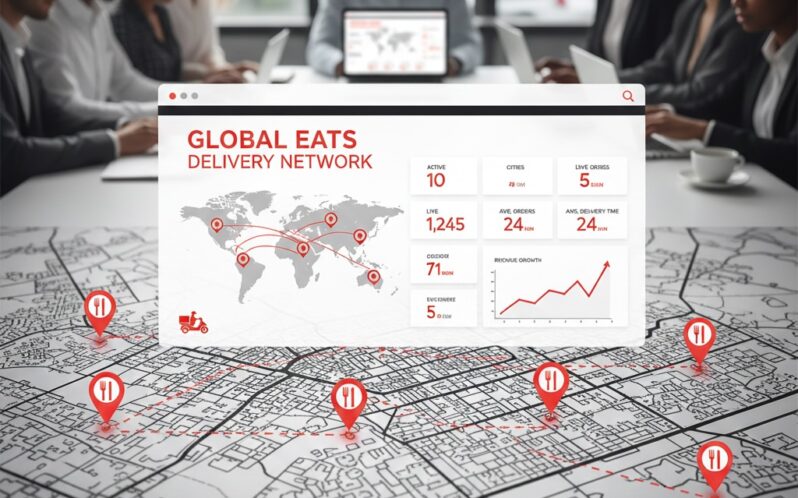
- Performance Dashboards: Monitor the “health” of each city in real-time, allowing you to pivot resources to a struggling market instantly.
Step 6: Maintain Quality Control at Scale
The most common reason for failure during expansion is the “dilution of quality.” As you move away from your home base, you must use technology to act as your eyes and ears on the ground.
- Automated Feedback Loops: Use in-app surveys to catch service dips in new cities before they lead to negative public reviews.
- Real-Time Monitoring: Use your admin dashboard to track “Late Delivery” trends or “Order Cancellation” rates across all ten cities.
- Support Tickets: Centralize customer support so your most experienced agents can handle issues from any city through a single interface.
To further solidify your expansion strategy, here are four additional critical steps to ensure your Food Delivery Marketplace System successfully manages a ten-city network.
Step 7: Localize Payment and Financial Logistics
As you move across different cities or regions, you may encounter varying tax regulations and preferred payment methods. A scalable system must automate these financial complexities to ensure trust with both vendors and customers.
- Multi-Currency & Tax Support: Configure your platform to automatically apply local tax rates and accept regional currencies for each specific city.
- Automated Vendor Payouts: Use automated split-payment technology to ensure restaurant partners are paid accurately and on time, reducing administrative friction.
- Digital Wallet Integration: Offer a built-in wallet system where customers can store credits and drivers can track their daily earnings in real-time.
Step 8: Build a Multi-Tiered Management Hierarchy
Managing ten cities requires a different organizational structure than managing one. Your marketplace system should provide granular permission levels so you can delegate authority without losing overall control.
- Super Admin Controls: Maintain a “God-eye” view of the entire ten-city network from a single master dashboard.
- City-Level Managers: Grant local managers access to only their city’s data, allowing them to manage local restaurant relationships and driver disputes independently.
- Role-Based Permissions: Assign specific access levels for customer support, dispatchers, and accountants to ensure data security and operational focus.
Efficiency Comparison: Internal Fleet vs. Third-Party Integration
| Feature | Internal Delivery Fleet | 3rd Party Logistics (3PL) |
| Brand Control | Maximum – drivers wear your gear | Lower – depends on 3rd party standards |
| Fixed Costs | High – payroll, insurance, vehicles | Low – pay only per successful delivery |
| Scalability | Slow – requires hiring and training | Instant – tap into existing driver pools |
| Data Visibility | 100% real-time GPS and behavior tracking | Limited to API data sharing |
Step 9: Optimize for App Performance and Speed
As your user base grows across ten cities, your server load will increase exponentially. A high-quality marketplace system must be built on cloud infrastructure that prevents crashes during peak ordering times like Friday nights or major sporting events.
- Cloud Scalability: Ensure your system uses auto-scaling cloud servers that add capacity as traffic spikes occur.
- Real-Time Order Tracking: Maintain low-latency connections so customers can see their driver’s precise location without the app lagging.
- Offline Mode Capabilities: Choose a system that can handle temporary network dips without losing order data or disrupting the kitchen flow.
Step 10: Implement Advanced Retention and Loyalty Engines
Acquiring a new customer in a new city is five times more expensive than keeping an existing one. Your system must include built-in marketing tools that automatically work to increase the frequency of orders across all locations.
- Referral Programs: Incentivize your users in City One to recommend your service to friends in City Two as you launch.
- Smart Push Notifications: Send automated, time-of-day alerts (e.g., “Lunch is ready!”) based on individual user ordering habits.
- Tiered Loyalty Rewards: Reward your most frequent users across all ten cities with VIP status, free delivery, or exclusive menu access.
Future-Proof Your Startup with FoodAppsCo™
Scaling from a local startup to a regional leader requires more than just an idea; it requires a technology partner that can grow with you. FoodAppsCo™ provides the most robust Food Delivery Marketplace System in the industry, specifically engineered for multi-city expansion.
With over 15 years of experience and a presence in major markets like the USA, UK, and UAE, we offer the global expertise you need to scale with confidence. Our 100% white-label solution means your brand stays at the forefront of every city you enter.
Scale Faster with FoodAppsCo™
Taking a startup from one city to ten is a monumental task that requires a partner who has been there before. FoodAppsCo™ provides a world-class Food Delivery Marketplace System that is currently powering hundreds of successful marketplaces across the globe.
Why Entrepreneurs Choose FoodAppsCo™ for Scaling
- 100% White-Label: Maintain full control over your brand identity as you expand into new territories.
- No Commission Fees: We don’t take a cut of your success. Keep 100% of your delivery and service fees to reinvest in your expansion.
- Enterprise-Grade Scalability: Our platform is built to handle millions of transactions and thousands of concurrent users across multiple cities.
- Multi-Market Support: Easily manage different currencies, tax laws, and languages from a single, intuitive master panel.
At FoodAppsCo™, we provide the technology so you can focus on the growth. From custom Android and iOS apps to a powerful web ordering interface and a driver management suite, we offer everything you need to become the next delivery giant.